

Think cover letters are a formality nobody reads? Think again. 83% of hiring managers read cover letters even when they aren't required, which means skipping optimization is quietly costing you interviews. Most job seekers recycle the same letter for every application, swapping out the company name and calling it tailored. That approach doesn't work. This guide breaks down why generic cover letters get ignored, what an optimized one actually looks like, and how you can use evidence-backed strategies to get more callbacks starting with your very next application.
Table of Contents
- Why most cover letters fail (and why optimized ones stand out)
- What makes an optimized cover letter: Key elements and evidence
- Debate: Do cover letters matter in the AI and skills-focused era?
- How to optimize your cover letter: Step-by-step guide
- The uncomfortable truth: Why most advice about cover letters misses the mark
- Ready to build your optimized cover letter?
- Frequently asked questions
Key Takeaways
| Point | Details |
|---|---|
| Tailoring gets results | Customizing cover letters dramatically improves your interview chances and helps you stand out. |
| Recruiters still read letters | A large majority of hiring managers value and read cover letters when considering candidates. |
| Optimization beats templates | Generic or copied letters are easily spotted—optimized ones demonstrate real fit and impact. |
| Strategic use matters | Cover letters deliver maximum impact in communication-focused roles and fields. |
Why most cover letters fail (and why optimized ones stand out)
Most cover letters fail before a recruiter finishes the first paragraph. The reason isn't bad writing. It's a lack of relevance. When you send the same letter to 20 employers, each one can feel it. Recruiters read hundreds of applications, and a generic opening like "I am excited to apply for this position" signals immediately that you didn't put in the work.
The three most common mistakes are easy to spot once you know what to look for:
- Copying the resume: Restating your work history word for word adds zero new information.
- No connection to the role: Failing to reference specific job requirements makes you look like you applied by accident.
- Vague value claims: Phrases like "I am a hard worker" or "I am passionate about growth" mean nothing without proof.
Recruiters aren't looking for a summary of your resume. They're looking for a reason to believe you're the right fit for this job at this company. As one hiring expert put it, a cover letter is your chance to show cultural fit and communication skills in a way a resume simply cannot.
"A cover letter is the one place in your application where your personality, motivation, and fit can come through clearly. A resume tells me what you've done. A cover letter tells me who you are."
So what does an optimized cover letter actually mean? It means a letter that is tailored to the specific job description, uses the company's own language, leads with measurable results, and demonstrates genuine knowledge of the role. It's not longer. It's smarter.
The data backs this up. 83% of hiring managers agree that a tailored cover letter makes candidates stand out, which means optimization isn't a nice-to-have. It's a competitive advantage. You can explore how Easy CV trends in AI-powered tailoring are reshaping what recruiters now expect from applicants.
The gap between a generic letter and an optimized one is wider than most people realize. Generic letters get skimmed and discarded. Optimized letters get you called.

What makes an optimized cover letter: Key elements and evidence
Now that we know why generic cover letters miss the mark, what exactly makes an optimized version so much more effective?
An optimized cover letter has three defining qualities: relevance, personalization, and a results focus. Relevance means every sentence connects directly to the job posting. Personalization means you've done real research on the company, not just read the About Us page. Results focus means you replace vague claims with specific numbers.
Here's how the components rank by impact:
- Tailored opening paragraph that names the specific role and shows you understand the company's current challenges.
- Skills match section that mirrors the exact language from the job description.
- Quantified achievements that prove your value with real data (percentages, revenue, time saved).
- Cultural fit signal that shows you understand what the team values beyond the job title.
- Clear call to action that invites next steps without sounding desperate.
Pro Tip: Replace every generic phrase with a specific metric. Instead of "I improved team performance," write "I reduced onboarding time by 30% over two quarters." Numbers are memorable. Vague adjectives are not.
The difference between these approaches is measurable. Personalized cover letters yield 61% more interview offers and a 35% higher hire rate. That's not a marginal improvement. That's a fundamentally different outcome.
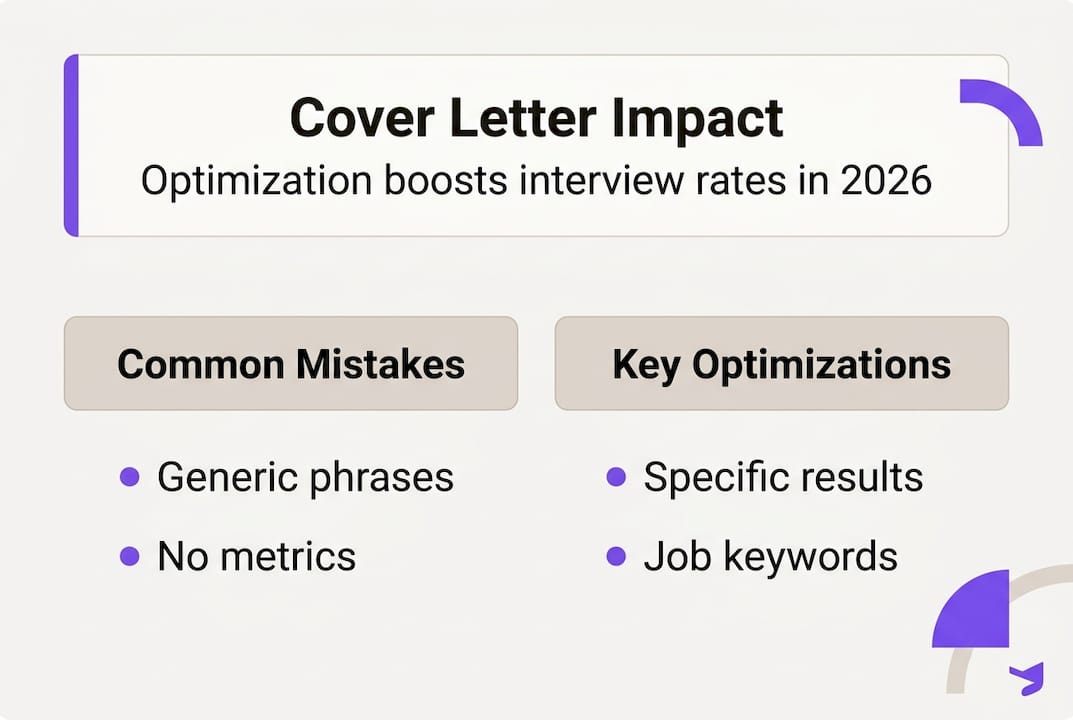
| Feature | Generic | Tailored | Optimized |
|---|---|---|---|
| Uses job description language | No | Partially | Yes, fully mirrored |
| Includes specific metrics | No | Rarely | Always |
| Reflects company culture | No | Sometimes | Researched and integrated |
| Personalized opening | No | Slightly | Yes, role and company specific |
| Interview conversion rate | Low | Moderate | Significantly higher |
The table makes it clear: optimization isn't just about effort. It's about strategy. Tailoring with Easy CV lets you match your letter to each job description automatically, so you get the benefits of a fully optimized letter without spending an hour on every application.
Debate: Do cover letters matter in the AI and skills-focused era?
With a clear picture of what makes optimization work, it's worth weighing the broader debate: Do cover letters still matter, especially with new hiring trends?
The answer depends heavily on who you ask. LinkedIn CEO Ryan Roslansky recently graded cover letters a "D," arguing that skills demonstration and portfolio work are far more valuable signals than a written letter. His position reflects a growing movement in tech and data-driven industries toward skills-based hiring, where what you can do matters more than how well you can describe it.
But that view isn't universal. Expert hiring advice from outside the tech sector tells a different story. In communication-heavy, creative, and client-facing roles, a well-written cover letter remains one of the most powerful tools in your application.
"For roles where writing, persuasion, or client relationships matter, a cover letter is essentially a live sample of your work. Skipping it is skipping the audition."
Here's when cover letter optimization has the most impact:
- Communication-heavy roles: Marketing, PR, sales, and consulting positions where writing ability is a core skill.
- Creative industries: Design, media, and content roles where voice and perspective matter.
- Senior or leadership positions: Where cultural fit and vision alignment are as important as technical skills.
- Smaller companies and startups: Where hiring managers personally read every application.
Pro Tip: Before writing your cover letter, check the job description for signals. If the role requires strong written communication, treat your cover letter as a writing sample. If it's a highly technical role evaluated on code or portfolio, keep the letter brief and let your work speak.
The smartest approach is to read the room. Explore modern recruitment trends to understand how different industries are weighing cover letters right now, and adjust your strategy accordingly.
How to optimize your cover letter: Step-by-step guide
Regardless of the shifting landscape, putting these optimization steps into practice will help you stand out where it counts.
Follow this workflow for every application:
- Paste the job description into a document and highlight the top five required skills and any repeated keywords.
- Research the company beyond the homepage. Read recent news, check their LinkedIn, and note the language they use about their culture and goals.
- Write a custom opening paragraph that names the role, the company, and one specific reason you're excited about this opportunity.
- Build your skills section using the exact phrases from the job description. If they say "cross-functional collaboration," use that phrase, not "teamwork."
- Add three quantified achievements that directly support the role's requirements. Use real numbers wherever possible.
- Close with a confident call to action that expresses enthusiasm and invites a conversation.
Pro Tip: Always use the company's own language and keywords. Applicant tracking systems often scan cover letters too, and matching the job description's phrasing improves your visibility before a human even reads your letter.
Here's a before and after comparison to show the difference optimization makes:
| Section | Before optimization | After optimization |
|---|---|---|
| Opening | "I am applying for the Marketing Manager role." | "Your recent campaign for [Product] caught my attention. I want to bring that same data-led creativity to your team as Marketing Manager." |
| Skills | "I have experience in social media." | "I managed a 3-channel social strategy that grew engagement by 47% in six months." |
| Closing | "I look forward to hearing from you." | "I'd love to discuss how my background in growth marketing aligns with your Q3 expansion goals." |
The impact is clear. Personalized cover letters raise interview offer rates by 61%, and the table above shows exactly where that lift comes from. Every section is an opportunity to be specific. Use it. Start building optimized cover letters with AI support to apply these steps faster and more consistently across every role you target.
The uncomfortable truth: Why most advice about cover letters misses the mark
Here's what the standard advice gets wrong: it treats cover letters as a fixed format problem when they're actually a strategic communication challenge.
Most guides tell you to follow a template. Introduction, body, closing. Three paragraphs. Done. But templates are the reason so many cover letters read identically. When everyone follows the same formula, no one stands out.
The real issue is that job seekers treat cover letter writing as a task to complete rather than a signal to send. Every word you choose tells a recruiter something about how you think, how you communicate, and whether you actually want this job or just a job.
The LinkedIn CEO's challenge to traditional cover letters is a useful provocation, but it's not a green light to skip them entirely. It's a signal to be smarter about when and how you use them. Static advice is obsolete. The job seekers winning interviews in 2026 are the ones who treat every application as a unique communication opportunity, not a form to fill out.
Tailor when it truly counts. Skip the template. Write like a human who actually wants the job.
Ready to build your optimized cover letter?
If you're ready to put these strategies into practice, here's the easiest way to get started.
You now know that tailored, optimized cover letters generate significantly more interview offers. The challenge is doing this consistently across every application without burning hours on each one.
The Easy CV builder uses AI to match your cover letter to each job description automatically, pulling in the right keywords, structuring your achievements, and helping you sound like the strongest candidate in the pile. You get the results of a fully optimized letter in a fraction of the time. Whether you're applying to five roles or fifty, Easy CV keeps every application sharp, relevant, and ready to convert.
Frequently asked questions
What does it mean to optimize a cover letter?
Optimizing a cover letter means customizing it for each specific job to highlight your most relevant skills and achievements. 83% of hiring managers say tailored cover letters help candidates stand out, making optimization one of the highest-impact steps in your job search.
Do hiring managers actually read cover letters?
Yes. 83% of hiring managers read cover letters even when it's not required, so treating yours as optional is a missed opportunity to make a strong first impression.
Does optimizing my cover letter increase my chances of getting an interview?
Personalized cover letters result in 61% more interview offers and improve hire rates by 35%, making optimization one of the most evidence-backed moves you can make in your job search.
Are cover letters less important for technical or AI-driven hiring?
For highly technical roles, some leaders like the LinkedIn CEO prioritize skills demonstration over traditional letters, but for communication-heavy or client-facing positions, a well-optimized cover letter still delivers a clear competitive edge.