

Most job seekers spend hours polishing their resume and then throw together a generic cover letter at the last minute. That's a costly mistake. The type of cover letter you choose signals to employers whether you understand the role, the company, and the industry before they even read your first sentence. 74% of hiring managers reject applications that are missing a requested cover letter outright. Choosing the wrong format, or worse, sending a one-size-fits-all letter, can knock you out of contention before your resume ever gets a look. This guide breaks down every major type, when to use each one, and how to make your choice work in your favor.
Table of Contents
- How to choose the right cover letter format
- The 5 main types of cover letters explained
- Industry insights: What employers really want in a cover letter
- Comparison table: Best-fit cover letter type for every scenario
- Our take: Why the right cover letter is more than a formality
- Upgrade your applications with Easy CV
- Frequently asked questions
Key Takeaways
| Point | Details |
|---|---|
| Choose by industry need | The best cover letter type depends on your target industry and job role expectations. |
| Tailoring matters | Customizing your cover letter to the job and company significantly increases your chance of success. |
| Understand letter types | Knowing when to use application, networking, prospecting, referral, or career-change letters is crucial. |
| Follow employer instructions | Never skip a cover letter when it’s requested, as most employers will reject incomplete applications. |
How to choose the right cover letter format
Before you write a single word, you need to answer one question: what does this specific application actually need? Not every job posting is the same, and not every cover letter serves the same purpose. The format you pick should match your situation, the industry you're targeting, and the stage of your job search.
Start with whether a cover letter is required, requested, or optional. If the job posting says "cover letter required," there's no debate. Submit one. If it says "optional," you should still include one in most cases. If the employer says "do not include a cover letter," respect that. Simple as it sounds, many applicants get this wrong and either skip it when it matters or include it when they were told not to.
Industry context matters enormously. Open rates in marketing and sales reach 73 to 81%, meaning hiring managers in those fields almost always read your letter. In tech engineering, that number drops to just 18%. If you're applying for a software engineering role at a startup, a long, narrative-driven cover letter may actually work against you. If you're applying for a brand manager role at a consumer goods company, skipping the letter could cost you the interview.
Key selection criteria to evaluate before writing:
- Role type: Is this a creative, analytical, relational, or technical position? Creative and relational roles benefit most from expressive, personalized letters.
- Seniority level: Entry-level applicants often need to explain their potential. Senior candidates need to demonstrate impact quickly.
- Industry norms: Finance, law, marketing, and sales expect polished, formal letters. Startups and tech companies often prefer brevity.
- Company culture: A formal bank and a design agency have completely different expectations. Research the company's tone through its website and social media.
- How you found the role: Did someone refer you? Are you applying cold? Did you see a job posting? Each scenario calls for a different type of letter.
Understanding how employers view cover letters in your specific field is the foundation of this decision. Once you know the context, choosing the right type becomes much more straightforward.
Pro Tip: Before writing, spend five minutes reading the company's "About Us" page and recent LinkedIn posts. Mirror their tone in your letter. A company that uses casual, energetic language in its content will respond better to a letter that feels human and direct, not stiff and corporate.
The 5 main types of cover letters explained
Now that you know how to choose, let's break down each cover letter type and where it shines. Each type has a distinct purpose, and using the wrong one sends the wrong signal to employers.
-
Application cover letter. This is the most common type. You write it in direct response to a specific job posting. It maps your skills and experience to the requirements listed in the job description. The goal is to show the employer that you are a strong match for this exact role. It should reference the job title, the company name, and at least two or three specific requirements from the posting. Generic application letters that could be sent to any company are the single biggest complaint hiring managers have.
-
Prospecting cover letter (also called a cold contact letter). This type targets companies that haven't advertised an open role. You're essentially reaching out to express interest and ask whether there might be a fit. It requires more research because you need to demonstrate genuine knowledge of the company's direction, challenges, or recent news. Prospecting letters work best in industries with tight networks, like advertising, fashion, or boutique finance firms, where many roles are filled before they're ever posted publicly.
-
Networking cover letter. This letter is written to a contact within your professional network, often to ask for information, introductions, or referrals. It's less formal than an application letter and more conversational. The focus is on the relationship and your shared context, not just your qualifications. These letters are especially useful when you're exploring a new field or trying to get a foot in the door at a specific organization through someone who already works there.
-
Referral cover letter. Similar to a networking letter, but more targeted. You've been specifically referred by someone inside the company or someone the hiring manager knows and respects. Always name the referral source in the opening line. Research consistently shows that referred candidates are more likely to get interviews than cold applicants, and your letter should capitalize on that connection immediately.
"A referral is social proof before the interview even starts. Your cover letter should acknowledge it directly and then back it up with substance. Don't let the referral do all the work." — Career coaching insight shared across multiple hiring forums.
-
Career-change cover letter. This is the most challenging type to write well, and the most important to get right. You're asking an employer to look past your unconventional background and see your potential. The letter must explain why you're making the switch, what transferable skills you bring, and why this specific company and role is the right fit for your next chapter. Vague explanations won't cut it. Be specific about what drew you to this field and what you've done to prepare for the transition.
Pro Tip: For career-change and referral letters, write a first draft that's twice as long as you need, then cut it in half. The editing process forces you to keep only the most compelling points, which is exactly what these high-stakes letters require.

Industry insights: What employers really want in a cover letter
Understanding the letter types is just step one. Here's what today's employers are really looking for, and it's not always what conventional wisdom suggests.
What hiring managers say versus what they actually do is one of the most interesting disconnects in recruiting. LinkedIn's CEO publicly graded cover letters a "D", suggesting they're an outdated formality. Yet data from the same period shows that in sales, marketing, and finance, hiring managers open and read cover letters at rates above 73%. The takeaway? The value of a cover letter depends almost entirely on who's reading it and in what industry.
A generic letter actively hurts you. Hiring managers can spot a template in seconds. When a letter doesn't reference the specific role, the company's recent work, or a concrete reason why this job fits your trajectory, it signals low effort. Low effort signals low motivation. That's a fast path to rejection, even when your resume is strong.
When tailoring is critical versus low-impact:
- High tailoring impact: Marketing, sales, PR, nonprofit, finance, law, academic roles, and any senior leadership position.
- Low tailoring impact: Entry-level tech engineering, data science roles at large tech firms, and positions where applicant tracking systems (ATS) filter before humans ever see your materials.
Top employer complaints and preferences (based on hiring manager surveys):
- Too long. One page is the standard. Anything beyond that rarely gets read in full.
- No specific examples. Saying "I'm a strong communicator" without evidence is meaningless.
- Wrong tone. A cover letter that's too casual for a law firm or too stiff for a creative agency shows poor cultural awareness.
- Repeating the resume. The letter should add context, not summarize what's already on the page.
- Errors in the company name or job title. This happens more than you'd think and is an immediate disqualifier.
"The best cover letters I've read tell me something the resume can't. They give me a reason to believe in the person, not just their credentials." — Senior recruiter at a mid-sized marketing firm.
Understanding cover letter employer expectations in your specific field before you write will save you time and dramatically improve your results.
Comparison table: Best-fit cover letter type for every scenario
To simplify your decision, see how each cover letter type stacks up for different job search scenarios below.
| Cover letter type | Best industry fit | Key strength | Main use case | When to avoid it |
|---|---|---|---|---|
| Application | All industries | Direct relevance to role | Responding to a job posting | Never avoid if requested |
| Prospecting | Advertising, fashion, boutique finance | Shows initiative | Targeting unadvertised roles | When the company has a clear "apply here" process |
| Networking | Any field in transition | Relationship-driven | Asking for referrals or info | When you have no genuine connection |
| Referral | Sales, marketing, finance | Social proof | Leveraging a known contact | When the referral hasn't agreed to vouch for you |
| Career-change | Any field you're entering | Explains the pivot | Switching industries or roles | When your background already fits the new field |
Cover letter value is highest in sales, marketing, and finance, and lower for entry-level tech roles, which should directly influence how much time you invest in each application.
Quick tips for making the final choice based on your job stage:
- Just starting your search? Default to the application letter and build a strong template you can customize quickly.
- Targeting a specific dream company? Use a prospecting letter and research the company thoroughly before writing.
- Switching careers or industries? A career-change letter is non-negotiable. Skipping it leaves too many questions unanswered.
- Someone referred you? Lead with the referral in your opening sentence and treat the rest of the letter as your supporting argument.
- Reaching out to a contact for advice? A networking letter works best here. Keep it short, genuine, and focused on the relationship.
The comparison above translates directly to action. Choose the type that matches your situation, adapt the tone to the industry, and skip the cover letter only when the employer explicitly says to. Every other scenario is an opportunity to stand out.
Our take: Why the right cover letter is more than a formality
Here's our candid take for job seekers in 2026: most people are solving the wrong problem. They obsess over formatting, font size, and length while completely ignoring the one thing that actually moves the needle, which is relevance.
A cover letter isn't a formality. It's a marketing document. And like any good marketing, it only works when it speaks directly to the audience's specific needs. The job seekers who consistently land interviews aren't the ones with the most polished templates. They're the ones who took twenty minutes to understand what the employer actually cares about and then wrote directly to that.
Conventional wisdom says cover letters are becoming optional. We'd push back on that. In competitive markets, in career changes, and in relationship-driven industries, a well-written, targeted letter is still one of the few ways to differentiate yourself before the interview. The bar is low because most people write bad ones. That's your opportunity.
Treat your cover letter like a pitch, not a summary. Be specific. Be direct. Give the employer one clear reason to call you before they've even opened your resume.
Upgrade your applications with Easy CV
If you're ready to put these insights into action, here's an easier way to stand out.
Writing a tailored cover letter for every application takes time, and most job seekers are applying to multiple roles at once. The Easy CV tool uses AI to help you generate and customize every cover letter type in minutes, matching your letter to the specific job description, company tone, and industry expectations automatically.
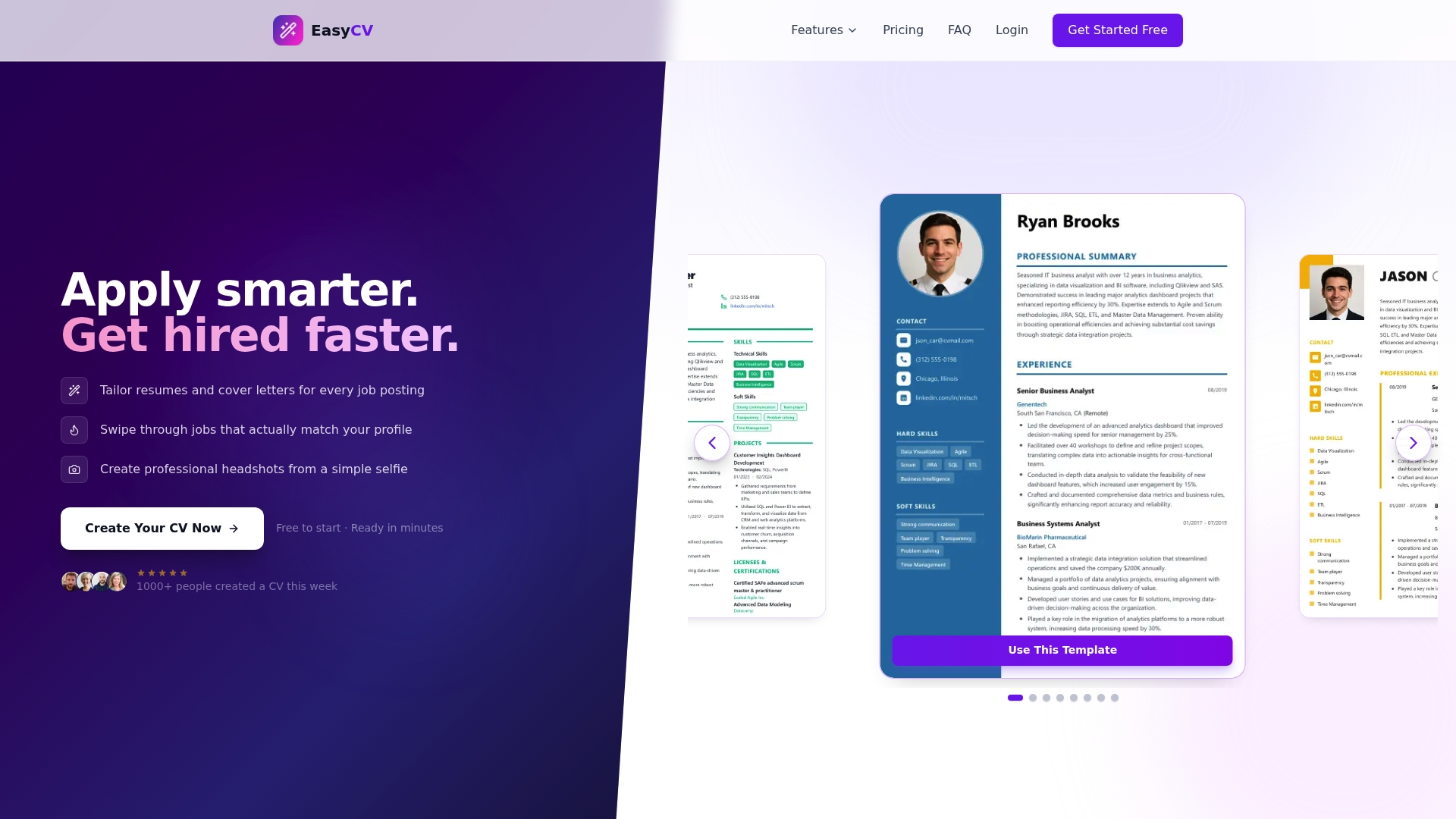
Whether you need an application letter, a career-change letter, or a prospecting letter for a company you've had your eye on, Easy CV handles the structure and language so you can focus on the substance. Explore the full Easy CV features to see how the platform supports every stage of your job search, and check Easy CV pricing to find the plan that fits your needs. Your next interview starts with a better first impression.
Frequently asked questions
Which type of cover letter is best for a career change?
A career-change cover letter explains your motivation, transferable skills, and how your background fits the new field. It's essential in competitive fields where open rates in marketing and sales reach 73 to 81%, and skipping it during a pivot leaves too many questions unanswered.
Do I still need a cover letter if the job description does not ask for one?
It's a smart move to include one unless the employer says not to. 74% of hiring managers reject applications missing a requested cover letter, and including one when it's optional often gives you an edge over candidates who skip it.
What is the main difference between an application and a prospecting cover letter?
Application letters respond to known job openings and map your skills to a specific posting, while prospecting letters target companies without advertised roles and require deeper research into the company's direction and needs.
How often do employers read cover letters?
Open rates vary widely by industry. In sales and marketing, open rates reach 73 to 81%, while in tech engineering the rate drops to just 18%, which means your investment in a cover letter should scale with the industry you're targeting.