

Submitting dozens of applications and hearing nothing back is one of the most demoralizing experiences in a job search. The problem usually isn't your qualifications. It's that automated screening systems, called Applicant Tracking Systems (ATS), filter out CVs before a human ever reads them. Generic, one-size-fits-all CVs are almost guaranteed to fail this first test. The good news is that AI tools now make it faster and smarter to tailor your CV for every job you apply to. This guide walks you through exactly how to prepare, optimize, and verify your CV so it gets seen by the right people.
Table of Contents
- What you need before optimizing your CV
- Step-by-step: How to tailor your CV for job boards
- Harnessing AI: Use technology the smart way
- Check, refine, and avoid common pitfalls
- Why the best CVs blend AI and authentic self-marketing
- Take the next step with Easy CV
- Frequently asked questions
Key Takeaways
| Point | Details |
|---|---|
| Tailoring doubles results | Customizing your CV to each job significantly boosts job board response rates. |
| AI as an editor | Use AI to enhance and edit your CV, not as a substitute for your real experience. |
| ATS optimization matters | Proper formatting and natural keyword use help your CV pass automated filters. |
| Final checks are crucial | Verify grammar, alignment with the job description, and ATS scoring before submitting. |
What you need before optimizing your CV
Before you touch a single keyword or rewrite a single bullet point, you need the right foundation in place. Skipping this step is like painting a wall without sanding it first. The result looks messy and doesn't last.
Start with a complete, up-to-date CV that includes every job you've held, every skill you've developed, and your full education history. This is your "master" document. You won't send this version to employers. Instead, you'll use it as the raw material to build tailored versions from. Think of it as your CV warehouse.
Next, collect several job descriptions for the roles you're targeting. Read them carefully. Notice which skills, tools, and phrases appear repeatedly. Those are your keywords. ATS software is designed to scan for exact matches between your CV and the job description, so understanding what recruiters are actually asking for is critical before you start editing.
Knowing resume basics matters here too. ATS systems don't read your CV the way a person does. They parse text, match terms, and score your document. Fancy graphics, tables, and unusual fonts can confuse the parser and cause your CV to score lower than it deserves.
Pro Tip: Build your master CV document now and set a calendar reminder to update it every three months. Adding achievements while they're fresh takes five minutes. Reconstructing them six months later takes an hour.
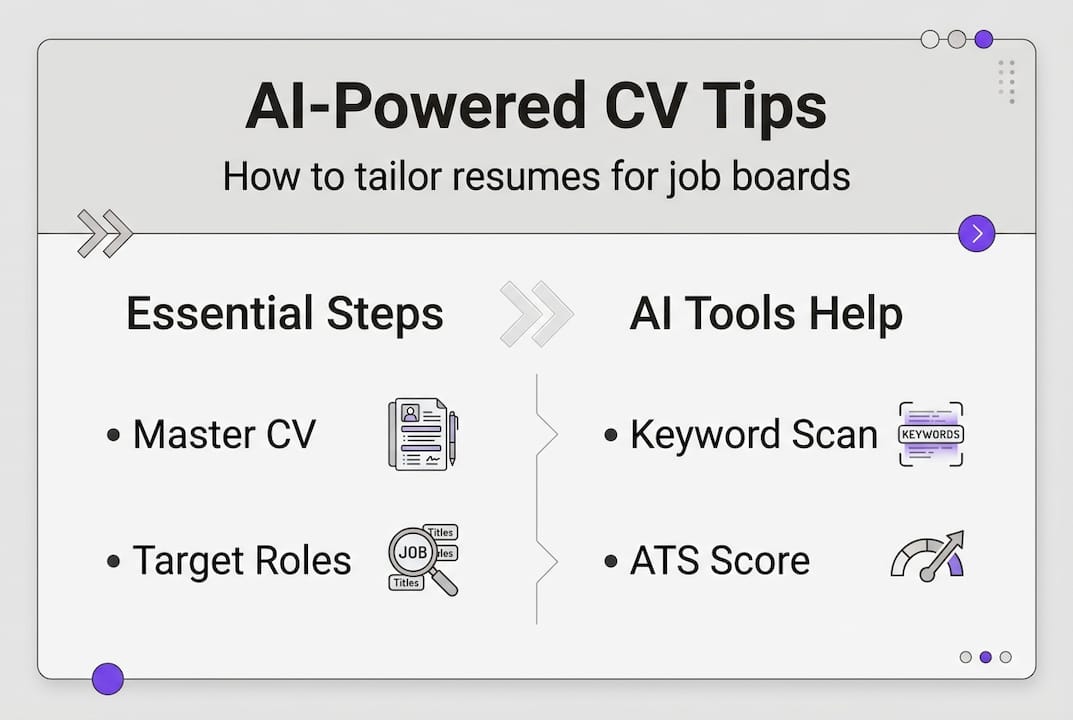
Here's a quick checklist to confirm you're ready to optimize:
| Prerequisite | Why it matters |
|---|---|
| Full master CV | Gives you complete content to draw from |
| 3 to 5 target job descriptions | Reveals the keywords you need to include |
| List of core skills | Helps you match your strengths to role requirements |
| List of role-specific keywords | Ensures ATS alignment for each application |
| Clean, simple CV format | Prevents ATS parsing errors |
Once you have all of these in place, you can maintain a full document CV and tailor it to each job in about ten minutes using keyword mapping. That efficiency is only possible when your foundation is solid.
AI resume tools can speed up this entire preparation phase by scanning job descriptions and surfacing the most relevant keywords automatically, saving you time and guesswork.
Step-by-step: How to tailor your CV for job boards
With your prerequisites ready, here's a clear step-by-step approach to optimize your CV.
The data makes a strong case for tailoring. Tailored CVs achieve 75 to 90 percent response rates compared to just 40 to 50 percent for generic ones. That's not a small difference. That's the difference between getting interviews and getting silence.
Here's how to do it right:
- Analyze the job description. Read it twice. Highlight the skills, tools, and responsibilities mentioned most often. These are your target keywords.
- Map keywords to your experience. Match each keyword to a real example from your work history. If you've used that skill, it belongs on your CV.
- Rewrite your professional summary. Your opening paragraph should mirror the language of the job description. If the role asks for a "results-driven project manager," your summary should reflect that framing.
- Update your skills section. Add role-specific tools and technologies that appear in the job ad. Remove skills that are irrelevant to this particular role.
- Use strong action verbs. Action verbs and quantified results are key to passing automated filters. Words like "led," "built," "reduced," and "increased" signal impact.
- Quantify your achievements. Numbers stand out. "Reduced onboarding time by 30%" is far stronger than "improved onboarding process."
Natural keyword integration is everything. Stuffing your CV with repeated terms doesn't fool modern ATS software, and it reads terribly to human recruiters. Here's how the two approaches compare:
| Approach | ATS performance | Recruiter impression | Recommended |
|---|---|---|---|
| Keyword stuffing | May pass initially | Reads as robotic and untrustworthy | No |
| Natural tailoring | Scores consistently higher | Reads as clear and credible | Yes |
For ATS keyword optimization, the goal is to use the right words in the right context, not to repeat them obsessively.

Pro Tip: Keep your CV formatting clean and simple. Use standard fonts like Arial or Calibri, avoid text boxes and graphics, and save your file as a .docx or PDF unless the job posting specifies otherwise. Simple formatting helps ATS parsers read every word correctly.
Using AI for resume editing at this stage can dramatically speed up keyword mapping and summary rewriting, especially when you're applying to multiple roles at once.
Harnessing AI: Use technology the smart way
With your CV tailored manually, AI can take your document to the next level. Here's how.
AI tools are genuinely useful for CV optimization, but only when you use them correctly. The biggest mistake job seekers make is treating AI as a ghostwriter. It isn't. It's a precision editing tool, and that distinction matters enormously.
Here's what AI does well when applied to CV improvement:
- Spellcheck and grammar correction that catches subtle errors a tired eye misses
- Keyword density analysis to flag whether your CV is over or under-indexed for key terms
- Professional summary rewriting to tighten language and improve clarity
- Formatting suggestions to ensure your layout is ATS-compatible
- Tone adjustments to make your CV sound confident without being overblown
Expert note: AI tools work best as editors, not authors. Your CV needs to reflect your actual experience, voice, and judgment. An AI-generated CV that doesn't match how you speak in an interview raises red flags. Use AI to sharpen what you've written, not to replace your thinking.
AI for editing, rather than primary writing, improves both clarity and keyword fit without stripping out your authentic voice. That balance is what separates a standout CV from a forgettable one.
When tailoring with AI, always review every suggestion before accepting it. AI doesn't know your career the way you do. It might suggest a phrase that sounds polished but doesn't accurately describe what you actually did. Your job is to keep what works and discard what doesn't.
Pro Tip: After running your CV through an AI tool, read it aloud. If a sentence sounds like something you'd never say in a real conversation, rewrite it. Your CV should sound like a confident, professional version of you.
Explore AI optimization tips to see how automated keyword mapping and ATS scoring can work alongside your own edits for the best possible outcome.
Check, refine, and avoid common pitfalls
Once your AI-tuned CV is ready, it's time for a final quality check.
Many job seekers skip this step entirely. They assume that because the CV looks good on screen, it will perform well in an ATS. That assumption costs interviews. A structured final review catches the errors that matter most.
Aim for an ATS match score of at least 80 percent before submitting your CV. Scores below that threshold are unlikely to reach a recruiter's desk. Most AI-powered CV tools can generate this score for you in seconds.
Here's a numbered checklist for your final review:
- Run an ATS test. Use a CV scoring tool to check keyword alignment with the job description.
- Check grammar and spelling. Read your CV backward, sentence by sentence, to catch typos your brain automatically skips.
- Verify alignment with the job ad. Every section of your CV should clearly connect to what the employer is asking for.
- Confirm your contact details are correct. Wrong phone number or email address means missed opportunities.
- Review your results section. Every role should include at least one quantified achievement.
Common mistakes that undermine job board results:
- Over-formatting with graphics, columns, or icons that confuse ATS parsers
- Keyword stuffing that reads unnaturally to human reviewers
- Ignoring the results section and listing only duties instead of achievements
- Using the same CV for every application without any tailoring
- Including an outdated objective statement instead of a modern professional summary
Using CV review tools to run a final ATS check takes less than two minutes and can be the difference between your application moving forward or getting filtered out automatically.
Why the best CVs blend AI and authentic self-marketing
Here's a perspective that most job search guides won't tell you. AI is not the competitive advantage. How you use it is.
Every job seeker now has access to the same AI tools. If everyone uses AI to generate their professional summaries, those summaries start to sound identical. Recruiters notice. They read hundreds of CVs, and a formulaic, AI-polished document stands out for the wrong reasons.
The real edge comes from using AI to sharpen your story, not to invent one. Your specific results, your career trajectory, and the way you describe your impact are things no AI can fabricate convincingly. When you feed your genuine experience into an AI editor and let it improve the clarity and structure, you get something powerful: a CV that reads professionally and sounds human.
Regular updates matter just as much as smart editing. A CV that reflects your most recent work, your current skills, and your evolving goals will always outperform a polished but outdated document. Treat your CV as a living document, not a one-time project.
The job seekers who get the most callbacks are the ones who combine thoughtful human input with precise AI editing. That combination is harder to replicate than a fully AI-generated CV, and it's far more compelling to read.
Take the next step with Easy CV
Ready to apply these strategies? Take your CV to the next level using Easy CV.
EasyCV.ai gives you everything you need to put this guide into practice immediately. Upload your existing CV and let the platform's AI-powered tools scan it for keyword gaps, ATS compatibility issues, and formatting problems. You can map keywords from real job descriptions, rewrite your professional summary with AI assistance, and generate a tailored version of your CV in minutes.
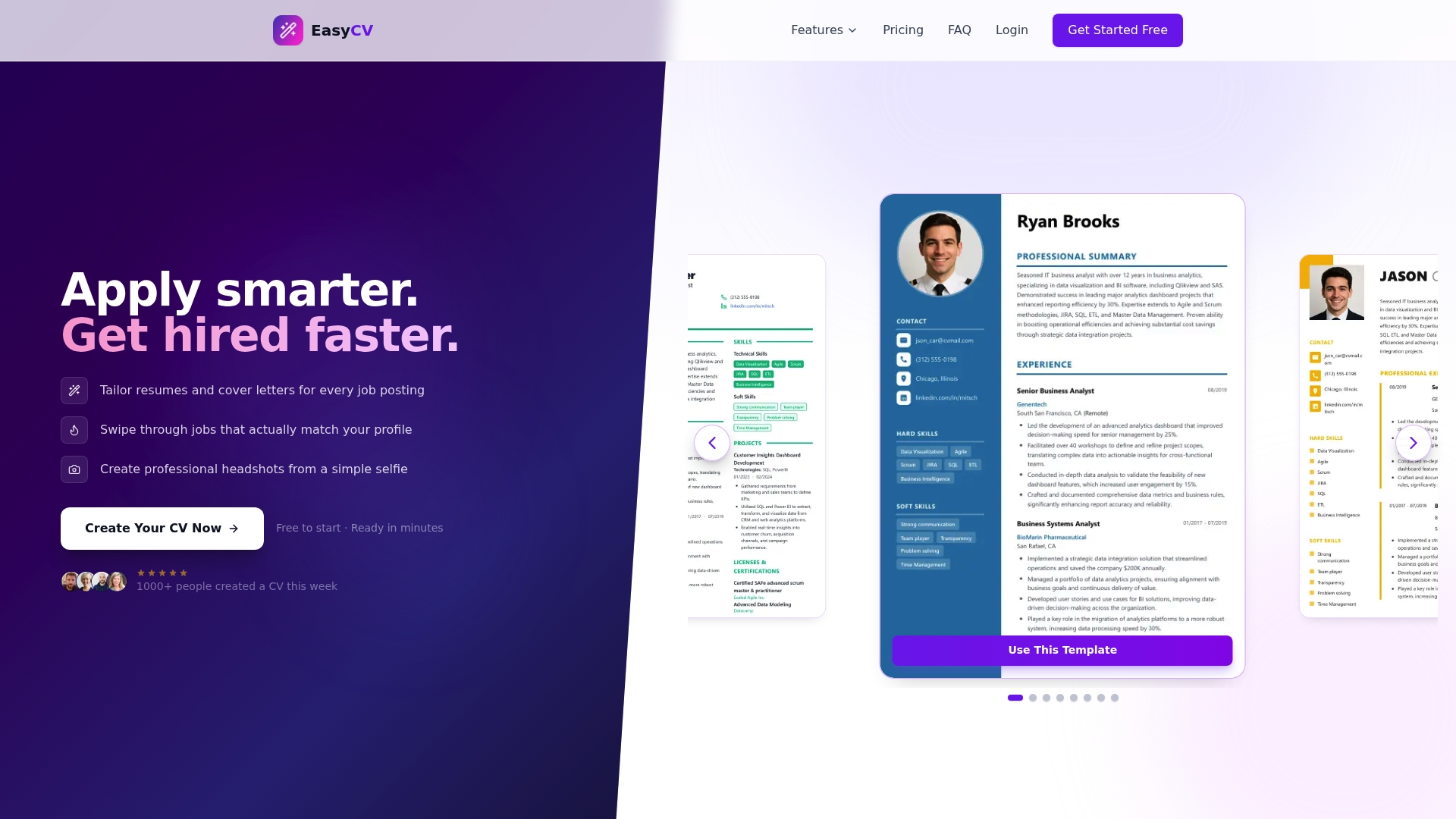
The Easy CV builder also supports cover letter generation, job matching across major job boards, and application tracking, so you can manage your entire job search from one place. Whether you're applying to three roles or thirty, EasyCV.ai helps you work smarter and get noticed faster. Start for free and see the difference a well-optimized CV makes.
Frequently asked questions
How can I make my CV ATS-friendly for job boards?
ATS systems prefer simple formats and natural keyword integration, so use clean layouts, standard fonts, and terms pulled directly from the job description. Avoid graphics, text boxes, and unusual formatting that parsers can't read correctly.
Is using AI to write my CV a good idea?
AI for editing, not primary writing, is the optimal approach. Your own experience and voice should drive the content, with AI refining clarity, grammar, and keyword fit.
What is a good ATS score for my CV?
Aim for an ATS match score of at least 80 percent, which is the threshold most recruiters use to decide whether a CV moves forward in the review process.
How do I avoid keyword stuffing when optimizing my CV?
Natural keyword integration is more effective than stuffing, so weave relevant terms into your experience descriptions and skills section in a way that reads naturally to both ATS software and human reviewers.